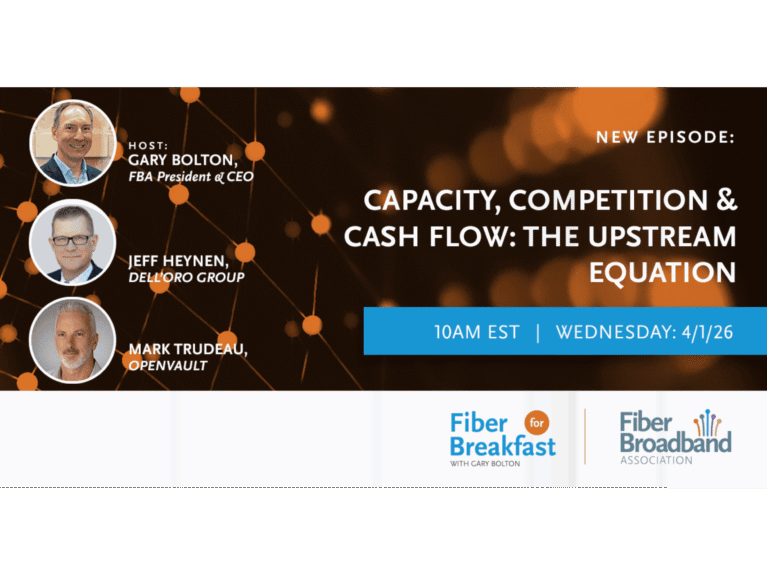

Fiber for Breakfast 2026 Week 13: Capacity, Competition & Cash Flow: The Upstream Equation

On this episode of Fiber for Breakfast, hosted by Fiber Broadband Association President & CEO Gary Bolton, we’re joined by Mark Trudeau, Founder & CEO of OpenVault and Jeff Heynen, VP of Broadband Access and Home Networking at Dell’Oro Group to unpack the 4Q25 OpenVault Broadband Insights report.

For the first time, the report compares Fiber and DOCSIS subscribers, revealing that symmetrical fiber speeds unlock significant pent-up upstream demand — with fiber users consuming 66% more upstream bandwidth. The conversation explores what this means for network investment, capacity planning, revenue growth, and the growing impact of absolute traffic increases on operator networks. Get your questions ready and register to attend!

With Special Guests:

  • Jeff Heynen, VP of Broadband Access and Home Networking, Dell’Oro Group
  • Mark Trudeau, Founder & CEO, OpenVault


Read the full Fiber for Breakfast summary article here!

Fiber for Breakfast 2026 Week 12: Tight Today, Transformational Tomorrow: A Historic Moment for Fiber

Fiber demand has reached a historic inflection point. In this episode of Fiber for Breakfast, Mike O’Day, head of Corning’s Optical Communications business joins Gary Bolton, President & CEO of the Fiber Broadband Association and shares his perspective on a remarkable growth cycle as innovation accelerates and AI takes center stage.

Mike explains how broadband expansion and the rapid buildout of AI infrastructure are reinforcing one another — creating shortterm supply pressure, but an even larger, longterm opportunity for the industry.

Today’s market is tight because the opportunity is big. Mike will discuss how Corning, celebrating its 175th year, is staying close to customers, investing in capacity, innovating to solve customer problems, and strengthening partnerships with rural operators. Mike will also highlight Corning’s commitment to support BEAD with BABA-compliant components through the life of the program.

Mike describes a virtuous cycle where more AI infrastructure leads to new AI applications, which fuels broadband demand — which in turn requires more AI infrastructure.

The takeaway is clear: BEAD and AI aren’t competing priorities — they’re part of the same growth cycle, with benefits extending far beyond fiber to communities and the broader digital economy. Register now to attend!

With Special Guest:

  • Michael O’Day, Sr. VP & GM, Optical Communications, Corning

Read the full Fiber for Breakfast summary article here!

Fiber for Breakfast 2026 Week 11: AI and the Network Effect: Where Carriers Win Next

For the past three years, Omdia has modeled and forecasted the impact of AI on network traffic through a cross-team effort spanning business and consumer trends, networks, hardware, software, devices, and facilities. In this week’s episode, Brian Washburn, Chief Analyst, Telco B2B Solutions, Omdia, joins Gary Bolton, President & CEO of the Fiber Broadband Association, to discuss Omdia’s latest AI network traffic reports, including its surveys, trackers, and forecasts.

As AI accelerates, network providers worldwide must strike a balance between protecting their core business—mobile and fixed connectivity—and participating in the broader AI opportunity. Brian shares his analysis of the significant challenges providers will face as AI reshapes network demand, as well as where the potential exists to capture greater revenue from this adjacent opportunity—if they move strategically. Register now!

With Special Guest:

  • Brian Washburn, Chief Analyst, Telco B2B Solutions, Omdia

Read the full Fiber for Breakfast summary article here!

Fiber for Breakfast 2026 Week 10: Mission Accomplished – or Mission Abandoned? Life After BEAD

As BEAD funding moves from promise to reality, what comes next for US broadband? In this timely conversation, Carol Mattey – industry veteran and founding member/principal of Mattey Consulting LLC – joins President & GEO Gary Bolton of the Fiber Broadband Association to explore the long-term impact of the BEAD program and the future of connectivity. Join in the conversation as they examine whether gaps in broadband coverage will remain, how LEO satellite services may factor into the equation, and if today’s 100/20 Mbps standard will be adequate or need to be re-examined after BEAD projects are completed. The discussion also tackles who will ultimately be responsible for closing any remaining gaps – industry, government, or communities and whether the FCC’s Universal Service Fund could play a pivotal role. Register now!

With Special Guest:

  • Carol Mattey, Founder, Mattey Consulting LLC

Read the full Fiber for Breakfast summary article here!

Built to Last: Jimmy Todd on Nex-Tech’s 75 Years of Change, Risk, and Growth

As Nex-Tech marks its 75th anniversary, Jimmy Todd, CEO and General Manager of Nex-Tech, joins Fiber Broadband Association President & CEO Gary Bolton for a conversation on what it takes to innovate and endure as a broadband provider in a rapidly changing technology landscape. Jimmy shares how Nex-Tech has transformed from a small telephone cooperative into a leading communications and technology provider, pioneering fiber-to-the-home and expanding services across more than 11,000 square miles of Kansas. Their conversation highlights the strategic choices, industry leadership, and commitment to rural communities that have defined Nex-Tech’s past and continue to drive its future.

With Special Guest:

  • Jimmy Todd, CEO & General Manager, Nex-Tech


Read the full Fiber for Breakfast summary article here!

Fiber for Breakfast 2026 Week 8: Broadband Competition and Pricing Strategies in California Urban Markets

On January 14, 2026, the California Public Advocates Office, in partnership with the University of California, Santa Barbara, released Broadband Competition and Pricing Strategies in California’s Urban Markets. The study examines how large incumbent providers respond to new competition from fiber and fixed wireless entrants across California’s urban communities.

In this week’s episode of Fiber for Breakfast, Ernesto Falcon, Program Manager at the CPUC, joins Gary Bolton, President & CEO of the Fiber Broadband Association, to unpack the findings. Drawing on market-level pricing data and deployment patterns, the report shows that meaningful facilities-based competition—particularly from new fiber providers—drives lower promotional pricing, enhanced service offerings, and more aggressive customer retention strategies.

Conversely, in markets without robust infrastructure competition, consumers often face higher prices under effective gigabit monopolies. The analysis reveals persistent market concentration across many urban areas and underscores the need for policies that promote sustainable infrastructure competition, pricing transparency, and strong consumer protections.

With Special Guest:

  • Ernesto Falcon, Program Manager, CPUC


Read the full Fiber for Breakfast summary article here!